

★★★★☆ 4.3 / 5
Bank of China Limited (BoC) is a Chinese state-owned commercial bank headquartered in Beijing. In the UAE it runs two licensed offices built entirely for corporate and institutional clients, not everyday consumers.
The Abu Dhabi branch opened at the end of 2014 under an onshore wholesale license from the Central Bank of the UAE. The Dubai branch sits inside the DIFC and is the direct successor to Bank of China Middle East (Dubai) Limited, BoC’s first Middle East subsidiary, set up in December 2012.
That subsidiary was dissolved in 2015 when its business transferred to the newly registered Dubai branch, according to Bank of China’s own corporate pages. Neither UAE office offers personal current accounts, debit cards, or consumer loans.

Quick answer: can I open a personal account here?
No. Both UAE offices hold wholesale or offshore licenses for corporate and institutional clients only. Individuals should use a UAE retail bank instead.
About Bank of China, the Parent Group
Bank of China was formally established in February 1912 and was restructured into a wholly state-owned commercial bank in 1994. It dual-listed on the Hong Kong and Shanghai stock exchanges in 2006, the first Chinese bank to do so.
In 2011 it became the first financial institution from an emerging economy designated a Global Systemically Important Bank, a status it still holds, according to Bank of China’s own corporate overview.
Group-wide, Bank of China operates across mainland China and in 64 other countries and regions, including 45 Belt and Road countries, and acts as the designated RMB clearing bank in 16 overseas markets. These figures cover the whole global group, not the UAE alone.
Rating Breakdown
| Category | Score |
| Corporate Product Range | 4.5 / 5 |
| RMB & Trade Finance Capability | 5.0 / 5 |
| Digital Banking (Corporate) | 3.5 / 5 |
| Branch & Physical Access | 2.5 / 5 |
| Regulatory Standing | 5.0 / 5 |
| Overall | 4.3 / 5 |
Who Should Bank Here
- Businesses with a Chinese counterparty that need RMB clearing, trade finance, and working capital lines in AED, USD, or CNH
- UAE corporates, government-linked entities, and infrastructure sponsors raising USD or CNH funding from Chinese lenders or bond investors
- Treasury desks that want a banking relationship physically based inside the China-UAE trade corridor
- DIFC-registered financial institutions that need a rated counterparty bank for FX deals, money-market placements, or bond settlement
Who Should Look Elsewhere
- Individual residents or expats who want a salary account, debit card, or personal loan. BoC UAE has no retail products at all
- Freelancers and small firms with no China-linked trade or ownership. Mainstream UAE banks are built for that segment; BoC UAE is not
- Anyone expecting a nearby branch or a round-the-clock helpline. The bank runs two offices nationwide and no walk-in retail network
Quick Facts

| Field | Detail |
| Bank Type | Foreign commercial bank: Wholesale / Corporate / Institutional Banking |
| Parent Group | Bank of China Limited (HQ: Beijing, China) |
| Founded (Parent) | 1912; restructured into a state-owned commercial bank in 1994 |
| UAE Presence Since | 2012 (Dubai / DIFC); 2014 (Abu Dhabi Branch) |
| Branch Network | 2 branches: Abu Dhabi onshore and Dubai DIFC |
| ATM Network | No proprietary retail ATM network in the UAE |
| Regulators in UAE | CBUAE (Abu Dhabi branch); DFSA (DIFC branch) |
| Digital Channels | Corporate e-banking portal: relationship managed; no public retail app |
| Languages Supported | English, Mandarin Chinese, Arabic |
| SWIFT/BIC Codes | Abu Dhabi: BKCHAEAA (BKCHAEAAXXX); Dubai DIFC: BKCHAEAD (BKCHAEADXXX) |
| UAE financial disclosure | The Abu Dhabi branch publishes audited annual financial statements, as required by the CBUAE Financial Reporting and External Audit Regulation |
| Auditor, Abu Dhabi branch | Ernst & Young Middle East (Abu Dhabi Branch) |
| Abu Dhabi branch profit, 2025 | AED 53.8 million after tax |
| Credit Rating | Set by Fitch, Moody’s, and S&P at parent-bank level. Ratings change periodically; check the current grade directly (links below) |
Pros & Cons
Pros
- Global balance sheet access. BoC ranks among the world’s largest banks by Tier-1 capital. UAE clients can tap that scale for financing sizes few regional banks can match alone.
- Full RMB and CNH toolkit. BoC UAE offers onshore RMB clearing, CNH settlement, and direct CIPS access. Few other UAE-licensed banks match this depth for Chinese-currency trade.
- China-Gulf deal experience. The bank has a long record in Belt and Road, energy, petrochemical, telecoms, and aviation financing between China and the Gulf.
- Active green bond issuer. The Dubai DIFC branch has issued Green Bond Principles-aligned bonds, confirmed on Bank of China’s own site, useful for ESG-focused investors.
- Two regulators, two structures. A CBUAE onshore license plus a DFSA license in the DIFC lets clients choose UAE federal law or DIFC common law for a deal.
- Globally systemic standing. The parent has been designated a Global Systemically Important Bank since 2011, a status confirmed on its own investor pages.
Cons
- No retail products. There is no personal account, debit card, credit card, or mortgage anywhere in BoC’s UAE operation.
- Minimal physical presence. Two offices cover the whole country, and BoC runs no ATMs in the UAE.
- Heavy onboarding. Corporate account opening involves full KYC, beneficial-ownership checks, and group-structure documentation. Small, simple businesses often find this disproportionate.
- Limited hours. The verified customer service lines run Monday to Friday, 9:00 to 17:30 Dubai time only, with no weekend or 24-hour cover.
- No self-service app. Everything runs through a relationship manager and the iGTB corporate portal. There is no consumer-style mobile app in the UAE.
Core Products & Services
BoC UAE serves corporate, institutional, and financial-institution clients only. Core lines include working capital loans, syndicated lending, trade finance, RMB clearing, treasury and FX, and correspondent banking for other banks.
Corporate Banking & Syndicated Lending
Bank of China frequently joins or leads cross-border loan syndications between Chinese and Gulf borrowers. Deal sizes typically start in the tens of millions of US dollars.
Products include working capital lines, term loans, revolving credit, and project finance for infrastructure, energy, aviation, and telecoms. Companies without a documented China connection are usually better served by a mainstream UAE bank.
Trade Finance
Trade finance is Bank of China’s strongest global capability, and the UAE offices carry the full toolkit. Letters of credit, documentary collections, guarantees, and supply-chain finance are all available.
Routing a letter of credit through BoC can shorten confirmation times when the counterparty is in China, since the parent bank settles directly there.
RMB Clearing & Cross-Border Settlement
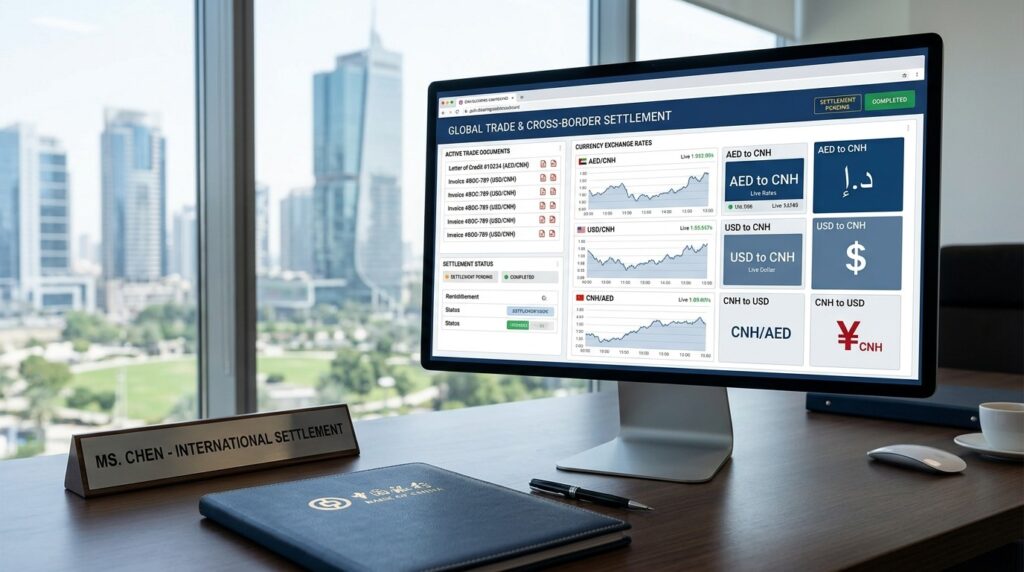
Bank of China is one of the world’s main offshore RMB clearing banks, serving as the designated RMB clearing bank in 16 overseas markets group-wide. Its UAE offices connect directly to CIPS, the Cross-Border Interbank Payment System.
For UAE companies invoicing or paying in Chinese yuan, this is a direct route into the onshore Chinese market without a US dollar intermediary step.
Regional Coverage from Dubai
Since succeeding BOCME in 2015, the Dubai branch’s business has grown to cover major countries across the Middle East, according to Bank of China’s own Dubai branch page.
Sectors served include sovereign wealth funds, infrastructure, oil and gas, petrochemicals, power, aviation logistics, telecommunications, and other financial institutions.
Treasury, Money Market & FX
Treasury products are sold only to corporate and institutional clients: money-market deposits, FX spot and forward contracts, and interest-rate swaps. Pricing is generally sharper on institutional ticket sizes than on smaller flows.
The Dubai DIFC branch issued Green Bonds in September 2023 and again in August 2024, aligned with the Green Bond Principles 2021. Proceeds are earmarked for new or existing green projects, per Bank of China’s own disclosures.
Financial Institutions Banking
BoC UAE runs correspondent accounts, nostro/vostro services, and interbank lending for other banks. Several UAE and GCC banks use it as their RMB correspondent.
Cards branded UnionPay, Visa, Mastercard, or JCB on Bank of China’s global site are issued in mainland China only, not by the UAE branches.
Opening a Corporate Account: What to Expect
BoC does not publish a public onboarding checklist for its UAE offices, since every relationship is negotiated individually. Based on the KYC and licensing rules both branches operate under, expect a process broadly like this. Confirm the exact steps with your relationship manager.
- Initial contact with a relationship manager to confirm your business fits BoC’s corporate or institutional focus
- Submission of company incorporation, ownership, and group-structure documents for beneficial-ownership review
- Compliance and AML screening under CBUAE rules for Abu Dhabi, or DFSA rules for the Dubai DIFC branch
- Agreement of account terms, fees, and any minimum balance in a signed account-opening letter
- Account activation and setup of iGTB corporate e-banking access
Fees & Charges: What to Confirm Before Signing

BoC UAE is a corporate bank, so fees are negotiated per client and set out in the facility or account-opening letter rather than a public retail price list. Confirm each of the following before signing anything.
- Account maintenance. Maintenance fees and minimum-balance rules for AED, USD, and CNH accounts are set per client. Ask for the exact AED-equivalent threshold in writing.
- Trade finance commissions. LC issuance, amendments, confirmations, and acceptances are usually a percentage of the transaction with a minimum floor, priced by tenor and country risk.
- Cross-border payments. SWIFT and CIPS transfers are charged per transaction, with separate same-day-value pricing. CNH payments via CIPS are typically cheaper than USD SWIFT routes.
- FX margin. Spreads on AED-CNH and AED-USD are tighter on institutional ticket sizes. Always request a live two-way quote from your relationship manager.
- Compliance timelines. Both branches enforce CBUAE and DFSA AML and KYC rules, including full beneficial-ownership disclosure. Build buffer time into any transaction or onboarding schedule.
- Dormant accounts. Accounts with no client-initiated activity for an extended period are flagged, and unclaimed balances are eventually transferred to the regulator under UAE Central Bank rules.
Digital Experience
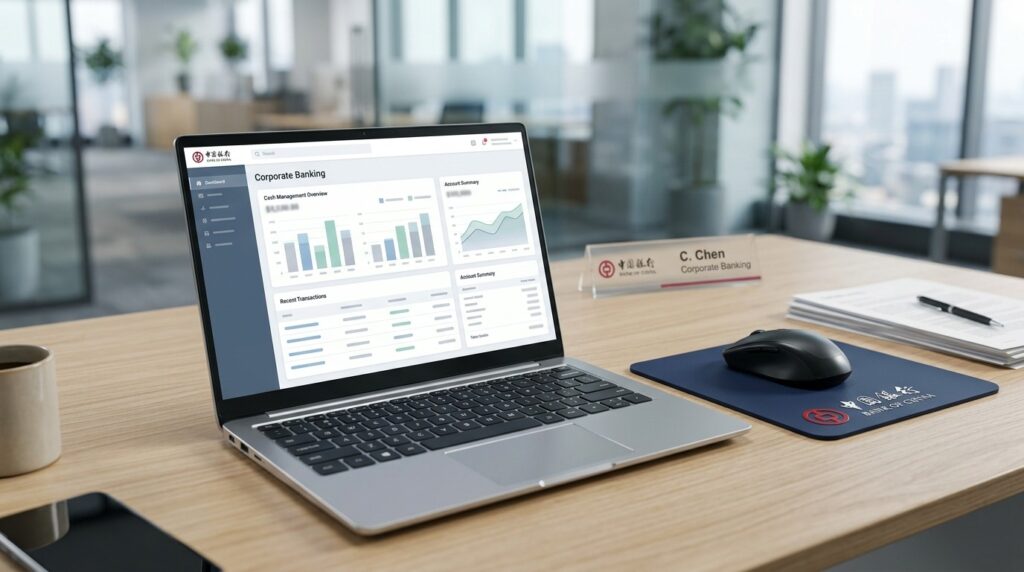
BoC’s UAE digital offering is corporate-grade, not consumer-grade. Clients reach every service through the group’s iGTB corporate e-banking portal.
What the Portal Covers
Multi-currency account views span AED, USD, CNH, and other major currencies. SWIFT and CIPS payment initiation, LC and guarantee instructions, and downloadable statements are all supported, with multi-user, dual-control approval workflows built in.
What It Does Not Offer
There is no retail mobile app for individual customers in the UAE. Card management, consumer lending journeys, and in-app self-service onboarding are all absent. Every complex request goes through the assigned relationship manager.
Contact Information & Customer Support
| Contact Type | Detail |
| Abu Dhabi Branch, Main Line | +971 2 418 0999 |
| Abu Dhabi Branch, Customer Service Hotline | +971 4 381 9100 |
| Abu Dhabi Branch, Fax | +971 2 418 0996 |
| Abu Dhabi Branch, Email | abudhabi.ae@bankofchina.com |
| Dubai DIFC, Customer Service Hotline | +971 4 381 9101 |
| Support Hours (both branches) | Monday-Friday, 9:00-17:30 Dubai time only |
Bank of China’s own contact page does not list a separate published main line or fax number for the Dubai DIFC branch beyond the hotline above. For any other Dubai DIFC contact detail, use the bank’s official contact page or ask your relationship manager.
Branch Addresses
Abu Dhabi Branch, onshore (CBUAE regulated). Unit 4608-4611, 46th Floor, Addax Commercial Tower, Al Reem Island, P.O. Box 73098, Abu Dhabi, UAE.
Dubai Branch, DIFC (DFSA regulated). Unit 1, 2, 3 & 4, Level 11 & 12, Currency House Tower 2, DIFC, P.O. Box 118842, Dubai, UAE.
Branch Network & UAE Coverage
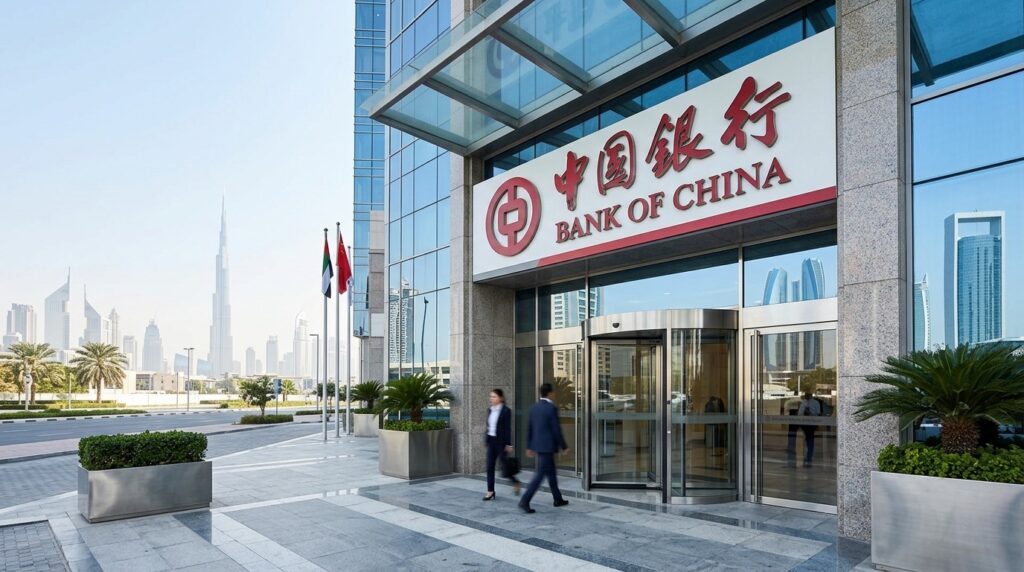
Bank of China operates exactly two licensed offices in the UAE. Abu Dhabi is an onshore wholesale operation regulated by the Central Bank of the UAE; Dubai sits inside the DIFC under the Dubai Financial Services Authority.
There are no sub-branches, retail kiosks, or proprietary ATMs anywhere in the country. Clients in other emirates are served remotely from whichever office holds their relationship.
| City | Branch Name | Regulator |
| Abu Dhabi | Addax Commercial Tower, Al Reem Island | CBUAE |
| Dubai | Currency House Tower 2, DIFC | DFSA |
Not the Only Chinese Bank in the UAE
Bank of China is not the only Chinese lender with a UAE presence, and it is easy to mix them up. Industrial and Commercial Bank of China, China Construction Bank, and Agricultural Bank of China also operate branches in Dubai or the DIFC.
Each of these is a separate legal entity with its own license, SWIFT code, and product range. Check the exact bank name and branch on any document before assuming it relates to Bank of China.
What the Abu Dhabi Branch’s Audited Accounts Show
Most foreign bank branches in the UAE are a black box. This one is not.
The Abu Dhabi branch has to publish audited annual accounts under the CBUAE Financial Reporting and External Audit Regulation. Ernst and Young Middle East signed the statements for the year ended 31 December 2025.
| Abu Dhabi branch | 2025 | 2024 |
| Net operating income | AED 97.3 million | AED 81.8 million |
| General and administrative expenses | AED 21.4 million | AED 17.5 million |
| Profit before provisions | AED 75.9 million | AED 64.3 million |
| Profit before tax | AED 75.8 million | AED 62.6 million |
| Income tax expense | AED 22.0 million | AED 18.2 million |
| Profit for the year | AED 53.8 million | AED 44.5 million |
The credit book tells a cleaner story than the profit line. Gross credit exposure was AED 2,265,767 thousand at 31 December 2025.
All of it sat in Stage 1, the performing bucket. The sub-standard, doubtful and loss grades were all nil, in 2025 and in 2024.
These numbers cover the Abu Dhabi branch only. The Dubai DIFC branch is licensed separately by the DFSA and does not publish its accounts in the same place, so none of the figures above describe it.
Paying a Beneficiary Held at Bank of China UAE
Get the branch right first. The two UAE offices have different BIC codes and different registered addresses, and they are not interchangeable.
We checked both codes against an independent SWIFT registry. The registered addresses match the branch addresses published by Bank of China itself.
| Branch | SWIFT/BIC | Address on the registry |
| Bank of China Abu Dhabi Branch | BKCHAEAA, or BKCHAEAAXXX in full | Addax Commercial Tower, Floor 46, Unit 4608-4611, Al Reem Island, Abu Dhabi |
| Bank of China (Dubai) Branch | BKCHAEAD, or BKCHAEADXXX in full | Currency House Tower 2, DIFC, Floor 11 and 12, Unit 1, 2, 3, 4, Dubai |
The beneficiary will always be a company, never an individual. Neither office holds personal accounts, so a payment addressed to a private person will not land.
Ask the beneficiary which of the 2 branches holds the account, and use the IBAN they give you. If you need proof a payment was sent, request the MT103 from your own bank.
FAQ: Bank of China Limited UAE
Can I open a personal account with Bank of China in the UAE?
No. Both UAE offices hold wholesale or offshore licenses and do not offer personal salary accounts, debit cards, or consumer loans. UAE residents should approach a local retail bank instead.
Is Bank of China UAE the same as Bank of China’s operations inside mainland China?
No. It is part of the same global bank but runs under separate UAE licenses from the Central Bank of the UAE and the DFSA. It does not sell the retail products, cards, or domestic services offered inside mainland China.
What is the SWIFT code for Bank of China UAE?
There are two codes. BKCHAEAA (BKCHAEAAXXX) is the Abu Dhabi branch, and BKCHAEAD (BKCHAEADXXX) is the Dubai DIFC branch. Confirm which one your counterparty needs before sending funds.
Does Bank of China UAE clear Renminbi?
Yes. RMB and CNH clearing is one of the bank’s core UAE capabilities, with direct CIPS access for corporate clients handling Chinese-currency trade or settlement.
What types of companies typically bank with BoC UAE?
Typical clients include Chinese state-owned and private enterprises, UAE conglomerates trading with China, sovereign wealth funds, infrastructure and energy developers, and DIFC-registered financial institutions.
Is Bank of China UAE regulated locally?
Yes, under two regulators. The Abu Dhabi branch is licensed by the Central Bank of the UAE. The Dubai branch operates inside the DIFC under the Dubai Financial Services Authority.
How long does corporate account opening take at BoC UAE?
It is fully relationship-managed and KYC-intensive. For a straightforward corporate file, expect a few weeks to around two months, depending on ownership and group-structure documentation.
Does BoC UAE issue credit or debit cards?
Not in the UAE. The UnionPay, Visa, Mastercard, and JCB cards shown on Bank of China’s global website are issued by the parent bank inside mainland China only.
Does Bank of China UAE offer weekend or 24/7 customer support?
No. The verified customer service hotlines for both branches run Monday to Friday, 9:00 to 17:30 Dubai time, with no weekend or after-hours line.
Can BoC UAE help my company access funding from Chinese banks?
Yes. Common routes include bilateral loans with the parent bank, participation in syndicated facilities arranged from Hong Kong or Beijing, and USD or CNH bond issuance with BoC as joint bookrunner.
Is Bank of China a globally systemically important bank?
Yes. It has held that designation since 2011, the first financial institution from an emerging economy to receive it, according to Bank of China’s own corporate overview.
Are there other Chinese banks in the UAE besides Bank of China?
Yes. Industrial and Commercial Bank of China, China Construction Bank, and Agricultural Bank of China also have UAE branches. Each is a separate entity with its own license and SWIFT code.
Can a Chinese citizen living in the UAE open an account with Bank of China UAE?
No. Nationality makes no difference. Both UAE offices hold wholesale or offshore licenses that cover corporate and institutional clients, so no individual can open a personal account regardless of passport.
Does Bank of China publish accounts for its UAE operation?
The Abu Dhabi branch does. It files audited annual financial statements under the CBUAE Financial Reporting and External Audit Regulation, and links them from its own branch page.
How much money does Bank of China’s Abu Dhabi branch make?
It posted a profit of AED 53.8 million for the year ended 31 December 2025, up from AED 44.5 million in 2024. Net operating income was AED 97.3 million.
Does Bank of China UAE have any bad loans?
Not at the Abu Dhabi branch. Its audited statements show the entire AED 2,265,767 thousand credit exposure in Stage 1 at 31 December 2025, with nil in the sub-standard, doubtful and loss grades in both 2025 and 2024.
Official sources
Everything above is compiled from primary sources fetched directly for this review. Check these pages yourself, because branch details, fees, and ratings change without notice.
- Audited UAE accounts: Bank of China Ltd. Abu Dhabi financial statements, year ended 31 December 2025, audited by Ernst & Young.
- Official website: Bank of China, including the Abu Dhabi branch page and Dubai DIFC branch page.
- Onshore regulator: Central Bank of the UAE, which licenses and supervises the Abu Dhabi branch.
- DIFC regulator: Dubai Financial Services Authority, which supervises the Dubai DIFC branch.
- SWIFT/BIC verification: Wise (Abu Dhabi code) and TheSWIFTCodes.com (Dubai code).
- Credit ratings: published directly by Moody’s and Fitch Ratings. Check the current grade before relying on it; we could not confirm a specific current letter grade from these pages at the time of writing.
- Our method: how we research each bank and what our ratings mean is set out in our editorial policy and ratings methodology.
Other international banks in the UAE
- HSBC UAE personal banking
- Standard Chartered Bank UAE
- Citibank UAE
- BNP Paribas UAE
- Credit Agricole CIB UAE
Still comparing? See the full list of all 62 banks licensed in the UAE, or read how we assess each one in our ratings methodology.