
★★★★☆ 4.2 / 5
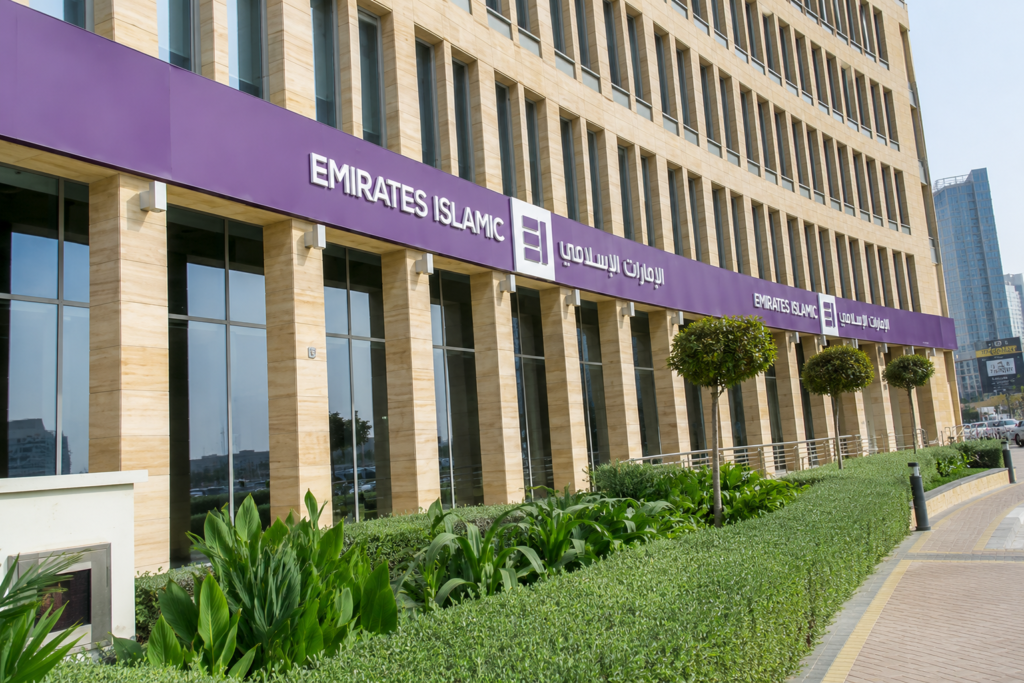
Emirates Islamic is a Shariah-compliant bank in Dubai, wholly owned by Emirates NBD. The bank’s own About Us page dates its launch to 2004, and its site footer states that Emirates Islamic Bank (P.J.S.C.) is licensed by the Central Bank of the UAE.
Emirates NBD bought out all remaining public shares in 2025, and EIB delisted from the Dubai Financial Market that year. It now runs as a wholly owned subsidiary rather than a separately traded stock.
For the first half of 2026, Emirates Islamic reported AED 1.7 billion in net profit and total assets of AED 153.8 billion, up 5.5% since the start of the year. Customer financing reached AED 97 billion and deposits reached AED 110.6 billion, both from the bank’s own results released in July 2026.
Below, every major product, fee, and support channel gets broken down so you can decide whether EIB fits your banking needs.
Fast fact: Emirates Islamic delisted from the Dubai Financial Market in 2025 after Emirates NBD bought out all remaining public shares. It now operates as a wholly owned subsidiary, not a separately traded stock.
Who Should Bank With Emirates Islamic
Certain customer profiles get noticeably more value out of this bank than others, so matching your situation against the list below saves time before you apply.
Ideal customers include:
- Residents who want Islamic-compliant banking that doesn’t feel restrictive on the digital side
- Emirates flyers chasing Skywards Miles through everyday card spending
- Salaried workers earning AED 5,000 or above who want a fee-free salary account
- Families and Emirati nationals hunting for home finance with fair profit rates
- SME owners who need trade finance, FX handling, and full Islamic business banking under one roof
- Customers who want Shariah-compliant digital gold and silver investing through a mobile app
Where Emirates Islamic Falls Short
No bank suits everyone, and EIB has clear gaps worth knowing about before you commit.
Less suitable for:
- Freelancers or contract workers without predictable monthly salary credits
- Anyone hunting for a completely fee-free account with no strings attached
- Customers who prioritize fast phone support, since call-centre wait times draw frequent complaints
- People who need a branch nearby in every district: EIB runs 40+ branches nationwide, a fraction of Emirates NBD’s larger network
Emirates Islamic Quick Facts Table
| Category | Details |
| Bank Type | Islamic / Retail / SME / Priority & Private Banking |
| Launched | 2004, per Emirates Islamic’s own About Us page |
| Ownership | Wholly owned by Emirates NBD PJSC; delisted from the Dubai Financial Market in 2025 |
| Head Office | Executive Office Building 16, Dubai Healthcare City, Dubai |
| Branches | Emirates Islamic publishes its network through a locator that loads in the browser, so we do not quote a branch count from a fixed page |
| ATMs/CDMs | Available nationwide; check the live branch and ATM locator for the current count near you |
| Total Assets (H1 2026) | AED 153.8 billion (+5.5% since start of 2026) |
| Net Profit (H1 2026) | AED 1.7 billion |
| App | EI+ (iOS & Android) |
| Languages | English, Arabic, Hindi, Urdu |
| SWIFT address | MEBLAEAD, published by the bank and confirmed in the BIC registry against Al Yousuf Tower, Deira |
| Phone banking | 600 599995, 24 hours a day, 7 days a week |
| Regulator | Central Bank of the UAE |
Official Emirates Islamic Resources
Before applying for any product, it’s worth going straight to the source rather than relying on secondhand information.
Emirates Islamic maintains an official website with a downloadable schedule of fees and a live branch/ATM locator tool. These pages get updated whenever pricing or terms shift, so checking them directly before opening an account or signing up for a card avoids relying on outdated numbers.
Advantages and Drawbacks of Banking Here
Weighing the strengths against the weaknesses gives a clearer picture than either list alone.
What works in EIB’s favor:
- Backed by Emirates NBD’s infrastructure, giving it liquidity and regulatory stability most standalone Islamic banks can’t match
- QuickRemit sends money to 40+ countries for free, arriving near-instantly with live tracking
- Skywards-branded cards rank among the strongest mile-earning products for Emirates flyers
- Flex Elite offers cashback-style rewards up to 3.75% on international spend, one of the higher rates in the local market
- ALPHA Youth accounts carry zero minimum balance for under-26 customers with no hidden fall-below charge
- Euromoney named EIB the World’s Best Islamic Digital Bank for 2025, and in 2026 it became the first UAE bank to offer Shariah-compliant digital gold and silver investing through the EI+ app
- Launched the UAE’s first Shariah-compliant Certificate of Deposit Programme in 2026 to diversify its funding base
Where it disappoints:
- A branch network roughly a fifth the size of parent Emirates NBD’s
- Recurring complaints about call-centre hold times and confusing IVR menus
- AED 26.25 monthly penalty if your balance dips below AED 3,000
- Expats need a higher minimum salary than several competitors to qualify for home finance
- Foreign debit card transactions cost 2.54% plus AED 21 per overseas ATM withdrawal
- Closing an account still requires an in-person branch visit
Core Emirates Islamic Products Explained
EIB’s product lineup spans everyday banking, travel and cashback cards, and Shariah-compliant home finance. Each is built for a slightly different customer, so understanding the eligibility bar matters before applying.
Salary and Current Accounts
Salaried expats and nationals form the core audience here. The standard Classic/Select tier asks for either AED 3,000 average monthly balance or a salary credit of AED 5,000+, and meeting either condition waives the AED 26.25 fall-below charge.
Account holders get a free debit card, a complimentary first chequebook, and full EI+ app access. Current accounts are available in 11 currencies, including AED, USD, GBP, EUR, and JPY, confirmed on Emirates Islamic’s own account page.
Under-26 customers qualify for ALPHA Youth, which drops the minimum balance requirement entirely.
How to Open an Account
Opening an account follows the same basic path across account tiers.
- Gather your passport, Emirates ID, and residence visa, or proof of employment if you’re a non-resident.
- Pick an account tier: Classic/Select, Advantage Banking, or ALPHA Youth for customers under 26.
- Apply through the EI+ app or at any branch; approval usually takes 1 to 3 business days.
- Activate your debit card and register for EI+ Mobile and Online Banking.
- Set up salary transfer or keep the required average balance to avoid the fall-below fee.
Advantage Banking
Higher earners can move up to Advantage Banking, which requires a salary transfer between AED 15,000 and AED 50,000, or an average balance of AED 100,000 or more over the last 3 months, both confirmed on Emirates Islamic’s own banking-package page.
In exchange, customers get 15 free teller transactions monthly, a debit card with AED 25,000 daily cash withdrawal limits, 20% off Safety Deposit Lockers, and access to more than 40 branches across the UAE.
Skywards Infinite Credit Card
Frequent Emirates flyers gravitate toward this card for its travel perks. The AED 999 annual fee is waived for the first year if you meet the card’s spend requirement of AED 30,000 within 180 days of approval, both figures confirmed on the card’s official page.
Perks include unrestricted global lounge access, complimentary Skywards Silver status, cinema tickets, valet parking, golf rounds, and travel insurance. For anyone flying Emirates at least a couple of times a year, the lounge access alone tends to offset the annual fee quickly.
Flex Elite Cashback Card
International spenders who want maximum rewards per dirham should look here. Cardholders earn up to 3.75 EI SmartMiles per AED 1 on qualifying international purchases, among the strongest rates available in the UAE.
SmartMiles convert to statement credit, travel bookings, or partner rewards, giving more flexibility than a pure airline miles program. Domestic spend earns at a lower rate, so this card rewards customers whose spending skews international.
Binaa Home Finance
Property buyers seeking a Shariah-compliant alternative to a conventional mortgage can use Binaa Home Finance, structured under Ijarah Muntahiya Bittamlik, a lease-to-own model confirmed on Emirates Islamic’s own home finance page.
The bank buys the property and leases it to you, and ownership transfers through a sale agreement once you complete the payments. No riba is charged at any stage of the lease.
Standard home finance runs up to 25 years, while commercial property finance caps at 15 years with financing up to 70% of the property’s value. Profit rates are linked to EIBOR and vary with tenure, property type, and the applicant’s credit profile.
UAE Nationals need AED 8,000 minimum monthly income; resident expats face a higher AED 20,000 bar. Applicants must be 21 or older and submit 6 months of bank statements, a recent salary certificate, and property paperwork, with pre-approval typically taking 5 to 10 working days.
Emirates Islamic also finances land purchase and self-construction in Restricted Properties areas reserved for UAE Nationals, plus government housing programs such as the Mohammed Bin Rashid Housing Establishment and the Sharjah Department of Housing.
| Home Finance Feature | Detail |
| Islamic structure | Ijarah Muntahiya Bittamlik (lease to own) |
| Max tenor, standard home finance | 25 years |
| Max tenor, commercial property finance | 15 years |
| Max finance to value, commercial property | 70% |
| Profit rate basis | Linked to EIBOR |
| Government housing programs | Mohammed Bin Rashid Housing Establishment; Sharjah Department of Housing |
How Emirates Islamic Actually Pays Profit on Your Savings
An Islamic bank does not pay interest. Emirates Islamic invests part of your balance in a Common Mudaraba Pool and shares the realized profit with you, and it publishes the exact percentages in a document on its own site.
The share of your balance that goes into the pool depends on which savings account you hold. These percentages have been in force since 1 August 2025.
| Savings account | Share of the balance invested in the pool |
| Kunooz Millionaire Account | 21% |
| Super Savings Account | 17% |
| Other savings accounts | 36% |
The bank names those other savings accounts as the Investment Savings Account, Child Savings Account, High Value Salary Account, STI Value Account and Special Investment Account.
The bank keeps 85% of the pool profit. As Mudarib, Emirates Islamic is entitled to 85% of the net profit of the Common Mudaraba Pool. It also reserves the right to change that fee at the start of any quarter, and to change the participation percentages at any time.
To take part at all you need AED 5,000 in a savings account, or AED 10,000 in an investment term deposit, or the dollar equivalent. Profit is paid no later than the 28th of the month following each quarter.
Investment Term Deposit Shares by Tenor and Size
Term deposits get a much larger share of the pool than savings accounts, and the share rises with both the tenor and the amount. The figures below are the percentages Emirates Islamic publishes, in force since 1 August 2025.
| Tenor | Under AED 100k | 100k to 3.5m | 3.5m to 25m | 25m to 50m | 50m to 100m | Over 100m |
| 3 months | 20% | 55% | 60% | 65% | 65% | 65% |
| 6 months | 30% | 60% | 65% | 70% | 70% | 70% |
| 9 months Flexi | 32% | 62% | 67% | 72% | 72% | 72% |
| 9 months | 35% | 65% | 70% | 75% | 75% | 75% |
| 1 year | 45% | 80% | 93% | 97% | 97% | 97% |
| 2 years | 50% | 85% | 95% | 100% | 100% | 100% |
Read the jump from 20% to 50% as the real cost of a short tenor. A 3 month deposit under AED 100,000 puts a fifth of your money to work in the pool, while a 2 year deposit of the same size puts in half.
The First Half of 2026, From the Bank’s Own Results
Emirates Islamic published its half year results on 23 July 2026. Every figure here comes from that release rather than from a summary of it.
| Measure | First half of 2026 | Change |
| Net profit | AED 1.7 billion | Net profit margin 3.1% |
| Operating profit | AED 2.2 billion | Up 10% year on year |
| Total income | Not broken out in the release | Up 8% year on year |
| Total assets | AED 153.8 billion | Up 5.5% since the start of the year |
| Customer financing | AED 97 billion | Up 9.1% since the start of the year |
| Customer deposits | AED 110.6 billion | Up 8.3%, with current and savings balances at 65% of deposits |
| Impairment allowances | AED 251 million charge | Expenses up 3% year on year |
| Non-performing financing | 2.5% | Coverage ratio 157.5% |
| Capital | Common Equity Tier 1 at 14.8% | Capital adequacy ratio 15.9% |
| Financing to deposits | 88% | Inside the bank’s stated target range |
The number that matters for a depositor is the 88% financing to deposit ratio and the 65% share of deposits sitting in current and savings accounts. Both point to a bank funded by everyday customers rather than by wholesale borrowing.
Hidden Fees and Charges to Watch
Reading the fee schedule before signing up prevents surprise deductions later.
| Fee Type | Cost | Notes |
| Fall-Below Balance Fee | AED 26.25/month | Waived for salary transfer holders, ALPHA Youth, minors, active finance customers |
| Foreign Currency Transaction (debit, abroad) | 2.54% + ~1.15% network fee | Plus AED 21 flat fee per overseas ATM withdrawal |
| QuickRemit (40+ countries) | Free | Real-time tracking included |
| Outward SWIFT Transfer | AED 94.50 (AED 78.75 for Advantage/ALPHA) | Correspondent bank charges apply separately |
| Early Account Closure | AED 105 | Waived after 6 months |
| Dormant Account | None charged | Central Bank unclaimed-funds rules may still apply |
| Inward Cheque Return | AED 105 per instance | Doubles to AED 210 if re-presented and returned again |
| Lost/Stolen Card Replacement | AED 26.25 | Initial card issuance is free |
Most of these charges are avoidable through simple account behavior, maintaining the minimum balance, keeping salary credits active, and using QuickRemit instead of standard SWIFT wherever the destination country supports it. Fees change without notice, so confirm current rates on Emirates Islamic’s published schedule of charges before you rely on any figure here.
Digital Banking: The EI+ App and Online Portal
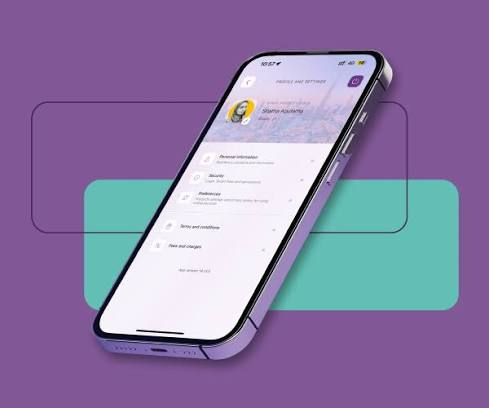
Emirates Islamic has invested heavily in digital banking, and the EI+ app reflects that.
The app covers over 200 features: transfers, bill payments, card controls, term deposit opening, and a personalized account dashboard. Euromoney’s 2025 recognition as World’s Best Islamic Digital Bank wasn’t just marketing, EIB was genuinely first among UAE Islamic banks to bring Shariah-compliant wealth management and equity trading into a mobile app.
In 2026, Emirates Islamic became the first bank in the UAE to let customers invest in certified physical gold and silver through the EI+ app. That same year it launched the UAE’s first Shariah-compliant Certificate of Deposit Programme, both confirmed in the bank’s own 2026 results.
Free QuickRemit transfers process near-instantly, transfers between EIB and Emirates NBD accounts happen instantly, and everyday tasks rarely require a branch visit.
That said, reviews on Google Play and the App Store report login glitches after major app updates, and support responses to in-app complaints can lag. Complex requests, account closure, home finance applications, still need a phone call or branch trip regardless of how polished the app is.
The EI+ web portal mirrors most app functionality for customers who prefer desktop banking, covering statements, transfers, and standard service requests reliably.
Getting Help: Contact Channels and Support
Multiple contact routes exist depending on what you need handled.
The 24/7 main call centre (600 599 995, or +971 600 599 995 from abroad) covers English, Arabic, Hindi, and Urdu. Priority Banking customers get a dedicated line at 800 111 22, confirmed on Emirates Islamic’s own priority banking contact page.
Business banking runs through +971 600 570003, also confirmed directly on Emirates Islamic’s business banking contact page. Trade finance, FX desk queries, and financial remediation each have separate email addresses, and the head office sits at Dubai Healthcare City, Building 16.
For lost cards or suspected fraud, calling immediately or blocking the card via the app is the recommended route. EIB explicitly advises against using the website’s general contact form for fraud reporting.
Branch Coverage Across the Emirates
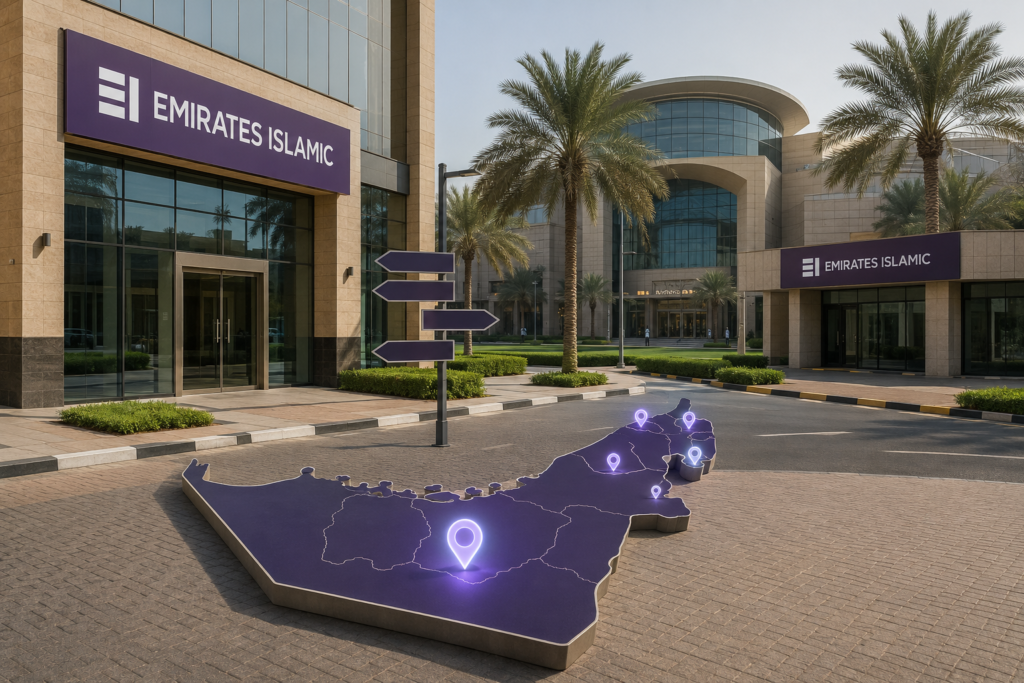
Physical presence still matters for many customers, particularly for cheque deposits or in-person finance applications.
EIB operates more than 40 branches across all seven emirates, a figure confirmed on Emirates Islamic’s own banking-package pages in 2026. The heaviest concentration sits in Dubai, covering areas from Healthcare City and Bur Dubai to newer developments like Dubai Hills and Dubai Festival City.
Abu Dhabi, Sharjah, Ajman, Al Ain, Ras Al Khaimah, Fujairah, and Umm Al Quwain each host branches too, based on the filters in Emirates Islamic’s own branch and ATM locator. Mall-based branches follow mall trading hours, while standalone street branches keep more traditional weekday timings.
Compared to Emirates NBD’s footprint, coverage is thinner, so customers in smaller towns may find the nearest branch a longer drive than they’d like. For the exact number of ATMs and CDMs near you, use the live branch and ATM locator on Emirates Islamic’s site, since counts shift as the network grows.
Where to Take a Complaint Emirates Islamic Does Not Fix
Complain to the bank first. Emirates Islamic runs phone banking on 600 599995, 24 hours a day and 7 days a week, and you should keep the date they received your complaint.
If 30 calendar days pass with no resolution, take it to Sanadak, the independent ombudsman unit created under the Central Bank of the UAE. Sanadak is on 800 726 2325 and sits in the Emirates Institute of Finance building in Abu Dhabi.
Its hours are 8:30am to 3:30pm Monday to Thursday and 8:30am to 11:30am on Friday. Emirates Islamic Bank (P.J.S.C.) is licensed by the Central Bank of the UAE, so it falls inside Sanadak’s remit.
Frequently Asked Questions
How do I open an account as a UAE resident?
You’ll need a passport with a valid residence visa, your Emirates ID, and proof of income such as a salary certificate, employment contract, or recent bank statement. Minimum age is 18, and applications can start through the EI+ app or at any branch, usually processing within 1 to 3 business days.
Can non-residents open an account?
Yes, non-residents need a passport, proof of employment or self-employment, and address verification such as a utility bill or a bank reference letter confirming at least 12 months of banking history. Minimum balance requirements tend to run higher than for resident accounts.
What’s the minimum balance requirement?
Classic/Select accounts need AED 3,000 average monthly balance, or the fee is waived with active salary transfers. Advantage Banking requires a salary transfer between AED 15,000 and AED 50,000, or an average balance of AED 100,000 or more over the last 3 months.
How much do international transfers cost?
QuickRemit transfers to 40+ supported countries are free with real-time tracking. Outside that network, standard SWIFT transfers cost AED 94.50 (or AED 78.75 for Advantage/ALPHA accounts), plus correspondent bank charges.
What’s the Emirates Islamic SWIFT code?
MEBLAEAD. Emirates Islamic publishes it on its own site, and the BIC registry lists the same code against Emirates Islamic Bank P.J.S.C. in Dubai, at Al Yousuf Tower, Deira. We found no separate branch code or routing code to quote.
How do I close my account?
A branch visit is required, with all balances cleared and linked products settled first. Closing within six months of opening triggers a AED 105 fee; after that, closure is free.
What happens if my account sits inactive?
No dormancy fee applies, though Central Bank rules on unclaimed funds may eventually flag long-inactive accounts. A single transaction periodically keeps the account active.
Does EIB offer investment products?
Yes, Wakala term deposits are available through branches and the app. In 2026, Emirates Islamic became the first UAE bank to offer digital gold and silver investing through the EI+ app, and it also launched the UAE’s first Shariah-compliant Certificate of Deposit Programme.
What Islamic structure does Emirates Islamic use for home finance?
Home finance uses Ijarah Muntahiya Bittamlik, a lease-to-own structure confirmed on the bank’s own site. The bank buys the property and leases it to you, then transfers ownership through a sale agreement once you complete the payments.
Is Emirates Islamic still listed on the Dubai Financial Market?
No. Emirates NBD bought out all remaining public shares in 2025, and Emirates Islamic delisted from the DFM that year. It now operates as a wholly owned subsidiary rather than a separately traded stock.
How does Emirates Islamic pay profit on a savings account?
It invests part of your balance in a Common Mudaraba Pool and pays you a share of the realized profit. The share of your balance that goes in is 21% on a Kunooz Millionaire Account, 17% on a Super Savings Account and 36% on its other savings accounts.
What minimum balance do I need to earn profit at Emirates Islamic?
AED 5,000 in a savings account, or AED 10,000 in an investment term deposit, or the equivalent in US dollars. Balances below that do not take part in the Common Mudaraba Pool.
How much of the profit does Emirates Islamic keep?
As Mudarib, the bank is entitled to 85% of the net profit of the Common Mudaraba Pool. It can change that fee at the start of any quarter and can change the participation percentages at any time.
When does Emirates Islamic pay the profit?
No later than the 28th of the month following each quarter, or after the bank’s Asset Liabilities Committee has met.
How big is Emirates Islamic?
Total assets were AED 153.8 billion at the end of June 2026, with customer financing at AED 97 billion and customer deposits at AED 110.6 billion. Net profit for the first half of 2026 was AED 1.7 billion.
Where do I escalate an Emirates Islamic complaint?
To Sanadak, the independent ombudsman unit created under the Central Bank of the UAE. Complain to Emirates Islamic first and wait 30 calendar days from the date they received it, then call Sanadak on 800 726 2325.
Official sources
Everything above is compiled from primary sources. Check these directly before you act, because fees and product terms change often and without notice.
- Common Mudaraba Pool disclosure: Emirates Islamic’s own participation percentages, Mudarib fee and minimum balances, effective 1 August 2025.
- Half year 2026 results: the bank’s own results release of 23 July 2026, the source for every figure in the results table.
- Who the bank is: Emirates Islamic About Us for the 2004 launch date and the Murabaha, Ijarah and Takaful structures it uses.
- Accounts terms and conditions: Special Features of Accounts, effective 1 September 2025, which carries the Profit Equalization Reserve and Investment Risk Reserve clauses.
- Fees: Emirates Islamic publishes its schedule of charges here. The page builds in the browser, so the individual amounts cannot be quoted from a fixed document.
- Regulator: Central Bank of the UAE, which licenses Emirates Islamic Bank (P.J.S.C.).
- Complaints: Sanadak, the independent ombudsman unit for licensed UAE banks.
- Our method: how we research each bank and what our ratings mean is set out in our editorial policy and ratings methodology.
Other Islamic banks in the UAE
Still comparing? See the full list of all 62 banks licensed in the UAE, or read how we assess each one in our ratings methodology.