

★★★☆☆ 3.4 / 5
Read this before anything else on the page. On 28 August 2026 the US Treasury sanctioned the general manager of Bank Melli’s Dubai branch.
The bank itself remains on the Central Bank of the UAE’s register of licensed banks. The section below sets out exactly what was announced and by whom.
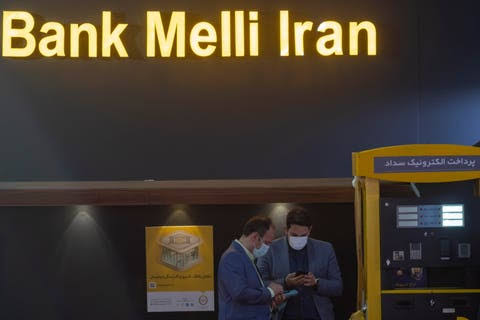
Bank Melli Iran, known as BMI, is one of the oldest banks operating in the UAE. Its licence number on the CBUAE register carries the year 1969, before the seven emirates united.
The parent institution traces its roots to 1928 Tehran, where it served for decades as Iran’s de facto central bank.
It runs 7 branches and a single pay-office across 6 emirates, from a regional headquarters on Baniyas Street in Deira.
This is a relationship bank built around trade between Iran and the UAE, not one chasing app downloads or card sign-up bonuses.
We could not reach Bank Melli’s own websites during this check. Both bmi.ir and the UAE domain failed to respond on 20 September 2026, so branch and fee details here could not be re-verified against the bank directly.
✓ Best For
- Iranian expats and dual-heritage families in the UAE who want a bank comfortable operating in Farsi alongside English and Arabic
- Import/export businesses running goods or capital between Iran and the Emirates who need Letters of Credit, Letters of Guarantee, or trust receipt facilities
- Customers outside the Dubai–Abu Dhabi bubble, since BMI has a presence in Al Ain, Ras Al Khaimah, and Fujairah that many boutique foreign banks skip entirely
- Savers who want a simple, low-barrier AED fixed deposit without being upsold on investment products
✗ Not Ideal For
- Anyone who banks primarily from their phone, there’s no BMI mobile app for the UAE market
- Customers hunting for credit cards, cashback, air miles, or any of the lifestyle perks bundled into accounts at larger retail banks
- Businesses that regularly wire large sums in USD to counterparties in the US or Europe, where sanctions screening can slow things down
- People who want dense ATM coverage, BMI’s machines only exist at its own seven branches, so you’ll lean on other banks’ networks for everyday cash access
Quick Facts
| Category | Details |
| Bank Type | Commercial, Retail & Trade Finance |
| Established | 1928 in Tehran. The UAE licence number on the CBUAE register carries the year 1969 |
| US sanctions status | The bank remains CBUAE-licensed. OFAC sanctioned the general manager of its Dubai branch on 28 August 2026 |
| Global HQ | Ferdowsi Street, Tehran, Iran |
| UAE Regional Office | Baniyas Street, Deira, Dubai |
| Branch Footprint | 7 branches + 1 pay-office, 6 emirates |
| ATMs | Located only at branch premises |
| Mobile App | None for UAE customers |
| Internet Banking | Yes, basic web portal |
| Languages | English, Arabic, Farsi |
| SWIFT Code | MELIAEAD |
| Working Hours | Sun–Thu core hours, closed Friday–Saturday weekend pattern varies by service desk |
Pros & Cons
✓ Pros
- More than half a century of UAE operating history, long enough to have weathered multiple regional banking cycles and built durable relationships with regulators and trade bodies
- Genuine multi-emirate reach, branches in Al Ain, Fujairah, and Ras Al Khaimah put BMI ahead of many smaller foreign banks that stop at Dubai’s city limits
- Deep trade finance bench strength, Letters of Credit, guarantees, and trust receipts are handled by staff who understand Iran–UAE trade specifically, not generic international desks
- Plugged into UAE payment rails, supports Aani instant payments and the Wage Protection System, so it isn’t isolated from domestic infrastructure despite its international profile
- Free account opening, no setup fee on personal accounts, and the AED 500 minimum balance for savings is genuinely low by local standards
✗ Cons
- No mobile app, everything digital routes through a browser-based portal that feels a generation behind competitors
- Thin ATM network, machines exist only inside branches, so cash withdrawals outside those locations mean relying on other banks and possibly paying inter-bank fees
- Sanctions exposure, as a bank with Iranian ownership, BMI sits under both US OFAC and EU sanctions frameworks, which can complicate or delay dollar-denominated transfers to Western counterparties
- Narrow product shelf, no credit cards, no travel rewards, no mortgage lending; the offering is deliberately focused on deposits, loans, and trade instruments
- Support hours are limited, there’s no 24/7 call center, so anything urgent outside branch hours has to wait
Detailed Product & Service Breakdown
Personal Savings Account
This is BMI’s entry-level product and probably where most individual customers start. The minimum balance sits at AED 500, which undercuts many mainstream UAE banks, and salary account holders don’t even need to maintain that. You get a debit card usable at BMI’s own ATMs plus online access for checking balances and moving money.
What you’re trading for that low entry point is convenience: interest rates aren’t published online, so you’ll need to call or visit a branch to get current figures, and the account leans on you being comfortable with in-person banking. It suits someone who wants a straightforward place to park savings rather than someone chasing the best possible yield or the flashiest features.
AED Fixed Deposit
For customers wanting a guaranteed return rather than a variable-rate savings account, BMI offers fixed deposits in local currency. What makes this product worth flagging is its dual use: beyond earning interest, a fixed deposit can be pledged as security for a bank guarantee.
When a guarantee is fully backed this way, BMI charges 1.05% per annum on the guarantee amount, as long as the deposit’s interest doesn’t exceed half the applicable guarantee rate. That structure is clearly built with trade clients in mind, a business that regularly needs guarantees for shipments or contracts can effectively recycle its own deposit as collateral rather than tying up separate capital. The catch is transparency: exact tenures, minimum deposit sizes, and current rates aren’t listed publicly, so pricing this out means a phone call to the regional office.
Trade Finance
This is where BMI genuinely differentiates itself from a typical UAE retail bank. The suite covers import and export Letters of Credit, Letters of Guarantee, trust receipts, and advances against export LCs, the full toolkit a trading business would need to move goods and manage payment risk across borders. Decades of operating specifically in the Iran-Gulf trade lane give BMI’s staff a level of familiarity that generalist trade desks at bigger banks often can’t match.
Commercial loans and overdraft facilities round out the offering for businesses that need working capital alongside their trade instruments. The one caveat worth taking seriously: because of sanctions on the parent institution, any trade finance touching US dollars or Western correspondent banks may hit friction. Businesses should have a direct conversation with BMI’s trade team about which currencies and corridors are actually workable before committing to a transaction structure.
Hidden Fees & Charges Explained
BMI’s fee schedule (last published for individual customers effective January 2023) is refreshingly short compared to larger retail banks, but a few line items deserve attention before you sign up.
Account opening itself is free across every personal account type, savings, current, and fixed deposit, so there’s no upfront cost to get started. The minimum balance requirements do carry weight, though: AED 500 for savings (waived for salary accounts) and a considerably higher AED 5,000 for current accounts, and dropping below either threshold can trigger charges under the bank’s schedule.
Outward transfers cost AED 105 per transaction under the standard tariff, though trade-related transfers can be priced differently, so it’s worth confirming with your branch before sending anything trade-linked. On the guarantee side, the 1.05% per annum charge for fixed-deposit-secured guarantees mentioned above is one of the more competitive rates for that type of facility, provided your deposit’s yield stays within the bank’s cap.
Because the full published schedule covers additional services beyond these headline items, statement reissuance, certificate fees, and similar administrative charges, it’s worth pulling the PDF or asking a branch officer directly rather than assuming the above list is exhaustive.
Digital Experience: App & Online Banking
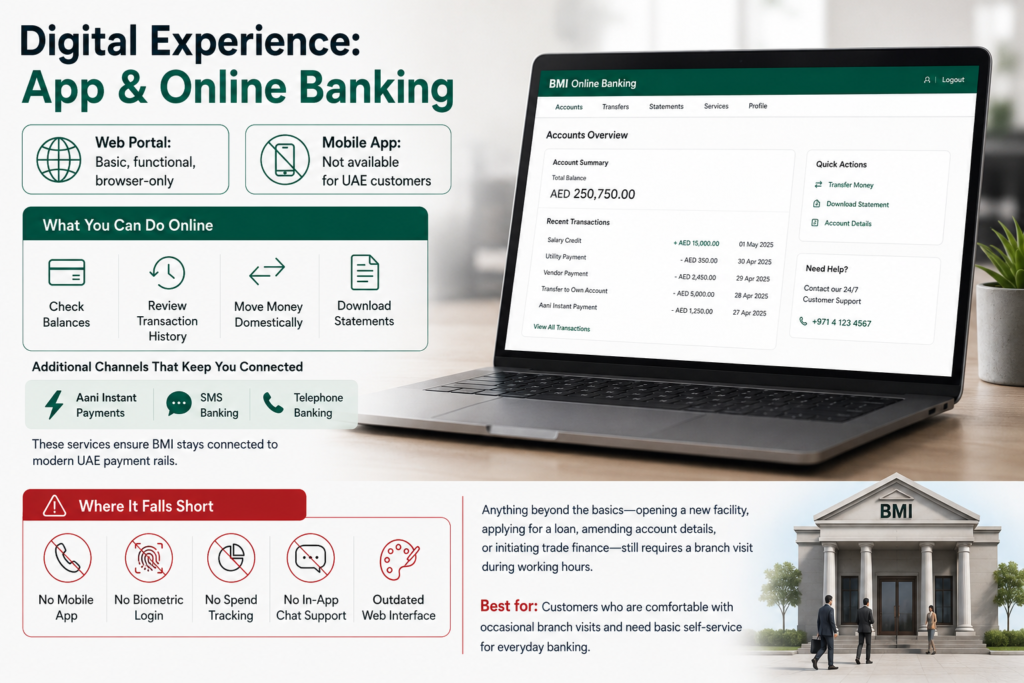
Web Portal: Basic, functional, browser-only
Mobile App: Not available for UAE customers
BMI’s online banking platform covers the fundamentals reasonably well, checking balances, reviewing transaction history, moving money domestically, and pulling statements are all possible without a branch visit. Aani instant payments, SMS banking, and telephone banking round out the channel mix, so BMI isn’t entirely cut off from modern UAE payment rails despite its old-school reputation.
Where it falls short is obvious the moment you compare it to any major retail bank’s app: there simply isn’t one. The web interface looks and feels like it hasn’t been redesigned in years, no biometric login, no spend tracking, no in-app chat support. Anything beyond the basics, opening a new facility, applying for a loan, amending account details, initiating a trade finance transaction, still requires walking into a branch during working hours. For a customer used to doing 90% of their banking from a phone, this will feel like a genuine step backward. For someone who’s fine with occasional branch visits and just wants basic self-service for day-to-day checking, it does the job without fuss.
Contact Information & Customer Support
BMI’s support structure is branch-centric rather than centralized. The Regional Office in Deira handles general enquiries and can direct you to the right department, while each branch maintains its own direct line and email for local matters, Dubai Main, Bur Dubai, Abu Dhabi, Al Ain, Sharjah, Fujairah, and Ras Al Khaimah all operate independently for day-to-day customer contact rather than routing through a single national call center.
Support is available in English, Arabic, and Farsi, which is a genuine advantage for the Iranian community specifically. The absence of a 24/7 helpline is the main gap: if something urgent comes up outside working hours, it waits until the next business day.
Branch & Coverage Availability
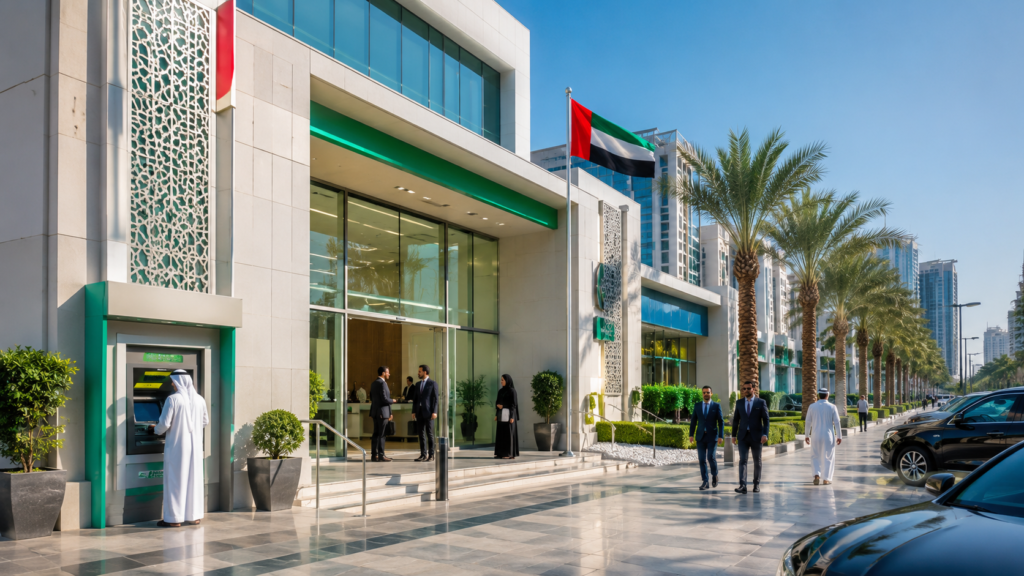
BMI’s seven branches plus one pay-office cover six of the UAE’s seven emirates, Dubai (which has two locations, the Deira main branch and a Bur Dubai branch, plus a small pay-office inside the Iranian Hospital in Satwa), Abu Dhabi, Al Ain, Sharjah, Ras Al Khaimah, and Fujairah. Notably absent are Ajman and Umm Al Quwain, so residents of those emirates will need to travel to a neighboring branch for in-person service.
Every branch location doubles as an ATM point, but since BMI doesn’t operate a wider standalone ATM network, that’s also the extent of your cash access unless you use another bank’s machine and absorb any inter-bank fee.
The 28 August 2026 US Treasury Action, Line by Line
This is the single most important thing to know about Bank Melli in the UAE right now. Everything below is quoted from the US Treasury’s own press release, not from news coverage of it.
The action sits under Operation Economic Outcast, announced by Treasury Secretary Scott Bessent on 24 August 2026.
| What Treasury announced | Detail |
| Who was sanctioned | Reza Mohammad Taeedi, an Iranian national who Treasury says serves as general manager of Bank Melli’s Dubai branch |
| Under what authority | Executive Order 13224, a counterterrorism authority |
| On what basis | For having acted or purported to act for or on behalf of, directly or indirectly, Bank Melli |
| Date | 28 August 2026 |
| Was Bank Melli itself newly designated in this release | The release describes OFAC taking additional action against Bank Melli and Iran’s shadow banking network, and names the branch manager as the person sanctioned |
Treasury’s stated reasoning is specific. It says Bank Melli has facilitated billions of dollars of transactions through accounts controlled by the Islamic Revolutionary Guard Corps Qods Force.
It adds that the bank has allowed the IRGC-QF and its parent organization, the IRGC, to move funds inside and outside Iran, and that IRGC-QF accounts at Bank Melli have been used to fund Iranian-aligned proxies and partners, including in Iraq.
A UAE licence and a clean international standing are two different things. Bank Melli Iran appears on the Central Bank of the UAE’s register of licensed banks, which means the CBUAE supervises it. That says nothing about whether a US dollar payment involving it will clear, or what a correspondent bank will do with it.
Treasury also stated that under Operation Economic Outcast, financial institutions around the world face heightened sanctions risk from exposure to Iranian financial facilitators.
Designations change in both directions and without notice. Check the OFAC sanctions list yourself before relying on any transfer, and take legal advice on a trade structure rather than a rule of thumb.
Nothing on this page is legal or sanctions advice. It is a record of what the primary sources said on the date we checked them.
Frequently Asked Questions
How do I open an account with Bank Melli Iran in the UAE?
Visit a branch in person with your passport, Emirates ID, and proof of address; salaried applicants also need a salary certificate. There’s no online application route, and no account opening fee is charged.
Can non-residents open an account?
BMI mainly serves UAE residents, though non-resident arrangements may be possible case by case. Contact the Regional Office directly to check eligibility and required documents.
What’s BMI’s SWIFT code?
The primary code is MELIAEAD, with individual branches carrying extended variants of the same base code.
What are the branch working hours?
Branches generally operate weekday mornings into early afternoon with reduced Saturday hours and closure on Sunday; exact timings can shift slightly by branch, so confirming with your specific location is worthwhile.
Does BMI offer credit cards?
No. The product range is limited to deposit accounts, personal and commercial loans, overdrafts, and trade finance instruments, no cards or lifestyle banking perks.
Does BMI support Aani instant payments?
Yes, alongside SMS and telephone banking, giving it at least baseline integration with the UAE’s domestic instant payment infrastructure.
How many branches does BMI have, and where?
Seven full branches across six emirates plus one pay-office in Dubai, with no presence currently in Ajman or Umm Al Quwain.
Is BMI affected by international sanctions?
Yes, as an Iranian-owned institution, it operates under US and EU sanctions frameworks, which can add friction to dollar transfers or dealings with Western correspondent banks, even though local UAE operations continue under Central Bank oversight.
Was Bank Melli’s Dubai branch manager sanctioned by the US?
Yes. On 28 August 2026 OFAC sanctioned Reza Mohammad Taeedi, whom Treasury identifies as the general manager of Bank Melli’s Dubai branch, under Executive Order 13224.
Is Bank Melli Iran still licensed in the UAE?
Yes. It appears on the Central Bank of the UAE’s register of licensed banks, with a licence number carrying the year 1969. A UAE licence is separate from any international sanctions position.
Can I send US dollars through Bank Melli Iran UAE?
Treat any US dollar route as high risk and check it first. Treasury has said that institutions worldwide face heightened sanctions risk from exposure to Iranian financial facilitators, and correspondent banks screen these payments closely.
Verify the current position on the OFAC list and take professional advice before committing to a transfer.
Where do I escalate a complaint about a UAE-licensed bank?
Complain to the bank first and keep the date they received it. After 30 calendar days without a satisfactory answer you can escalate to Sanadak, the independent ombudsman unit created under the Central Bank of the UAE.
Official sources
Everything above is compiled from primary sources. Check these directly before you act, because fees and product terms change often and without notice.
- US Treasury action, 28 August 2026: Operation Economic Outcast press release, the source for every sanctions statement on this page.
- Sanctions lists: OFAC Iran sanctions programs, which is where to check the current position before any transfer.
- Complaints: Sanadak, the independent ombudsman unit created under the Central Bank of the UAE.
- Regulator: Central Bank of the UAE, which licenses and supervises every bank operating in the UAE and handles escalated consumer complaints.
- Our method: how we research each bank and what our ratings mean is set out in our editorial policy and ratings methodology.
Other regional banks in the UAE
Still comparing? See the full list of all 62 banks licensed in the UAE, or read how we assess each one in our ratings methodology.